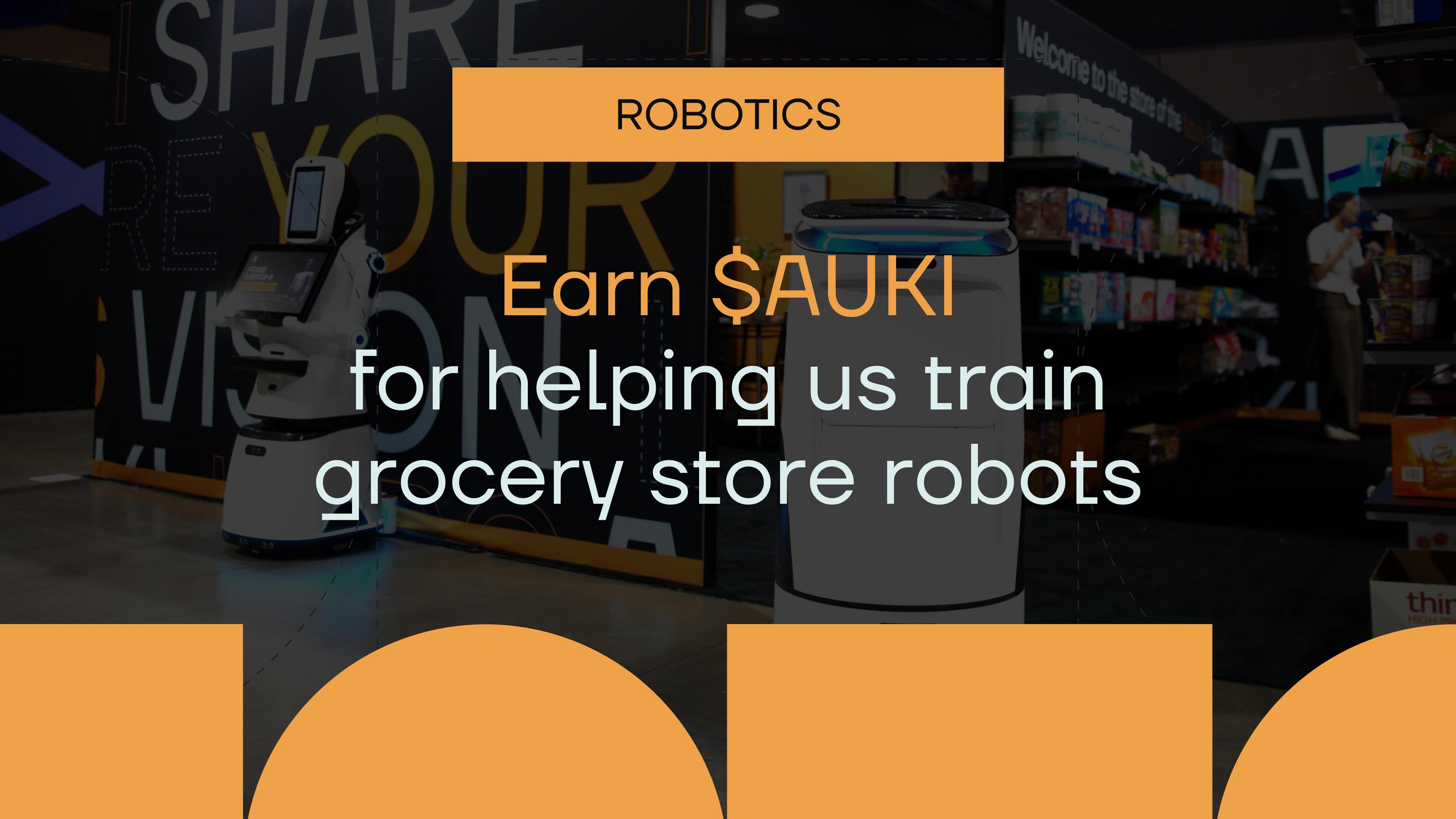
Join the movement and participate on Uniswap.
Participate

This week’s community update comes from Beijing. Nils is back for the first time since COVID, returning to a city where he lived for seven years.
The trip has two main purposes:
Galbot is one of Nils’ favorite Chinese robot companies, known for impressive live demos. Roboterra is newer to us in person, but looks promising on paper.
Our 2026 goal has become pretty concrete: roughly 500 semi-humanoid robots doing real work in grocery stores.
That means hardware budgeting is getting real too:
To pull this off, we’ve been talking with Taiwanese banks and financial institutions about credit lines specifically to finance these deployments.
The contrast with Europe is stark. “It would certainly not be easy for me to get funding to do this from a Swedish bank,” Nils says. “Really excited to be in Asia where people believe in the robots.”
Between Taiwan’s financiers and China’s robot OEMs, Asia is the natural launchpad for scaling our robot fleet.
While Nils has been on the road, the Hong Kong lab has been busy too. This week we:
The takeaway: it's nice to have reached the stage where large, traditional enterprises are flying teams halfway across the world to see how our network, AI Copilots and robots fit into their operations.
End of year is always chaotic, and this one is no exception.
Next stop for Nils is Europe, where he’ll:
“Hopefully December 17th is going to be a very important day for us… our last missing signature on a very important deal.”
If that signature lands, there’s a real chance we go into 2026 already profitable.
Given where we were a year ago, that’s a huge shift in our position and negotiating power.
On top of that, we’re seeing new deals in Asia come in with a strong sense of urgency:
Good news for the company, slightly worse news for anyone dreaming of a long, quiet Christmas. “People were hoping to take more time off for Christmas this year, and it looks like we’re going to be very busy for Christmas rolling out these new locations.”
We’ve finally committed to a date for a proper year-in-review community update:
“It’s been a crazy year… we are just in such a different position now than we were a year ago.” Expect that session to cover the arc from “are we crazy?” to “this might actually work,” plus where we are heading next.
We also got a quick preview of a big technical step: Gaussian scene reconstruction as the rendering layer for domains.
Until now, many of our demos showed point clouds – useful for robots, but not exactly human-friendly. The new work lets you:
The goal is to let anyone:
“This is the upcoming rendering layer of the domain… our goal is for you guys to be able to go play with this before the end of the year and set this up.”
This ties directly into the community initiative.
We’re planning to let the community create domains and sell them to us for $AUKI tokens, under a clear rule:
The ambition is bold but realistic: “Hopefully, as a community, we can come together and create the world’s largest open source data set of scanned environments so that people can do real-to-sim-to-real pipelines.”
Why this matters:
It is also a very clean example of what we always wanted the token to be used for: rewarding real work in the physical world that strengthens the network.
Finally, a quick note on Intercognitive, the space where AI, robotics, spatial computing, and human cognition overlap.
“I think that 2026 is going to be a great year not just for us but also for Intercognitive.”
As always, the community update ended with the usual split:
If you want to be in the room when those conversations happen, you know where to find us.
Auki is making the physical world accessible to AI by building the real world web: a way for robots and digital devices like smart glasses and phones to browse, navigate, and search physical locations.
70% of the world economy is still tied to physical locations and labor, so making the physical world accessible to AI represents a 3X increase in the TAM of AI in general. Auki's goal is to become the decentralized nervous system of AI in the physical world, providing collaborative spatial reasoning for the next 100bn devices on Earth and beyond.
X | Discord | LinkedIn | YouTube | Whitepaper | auki.com