Join the movement and participate on Uniswap.
Participate

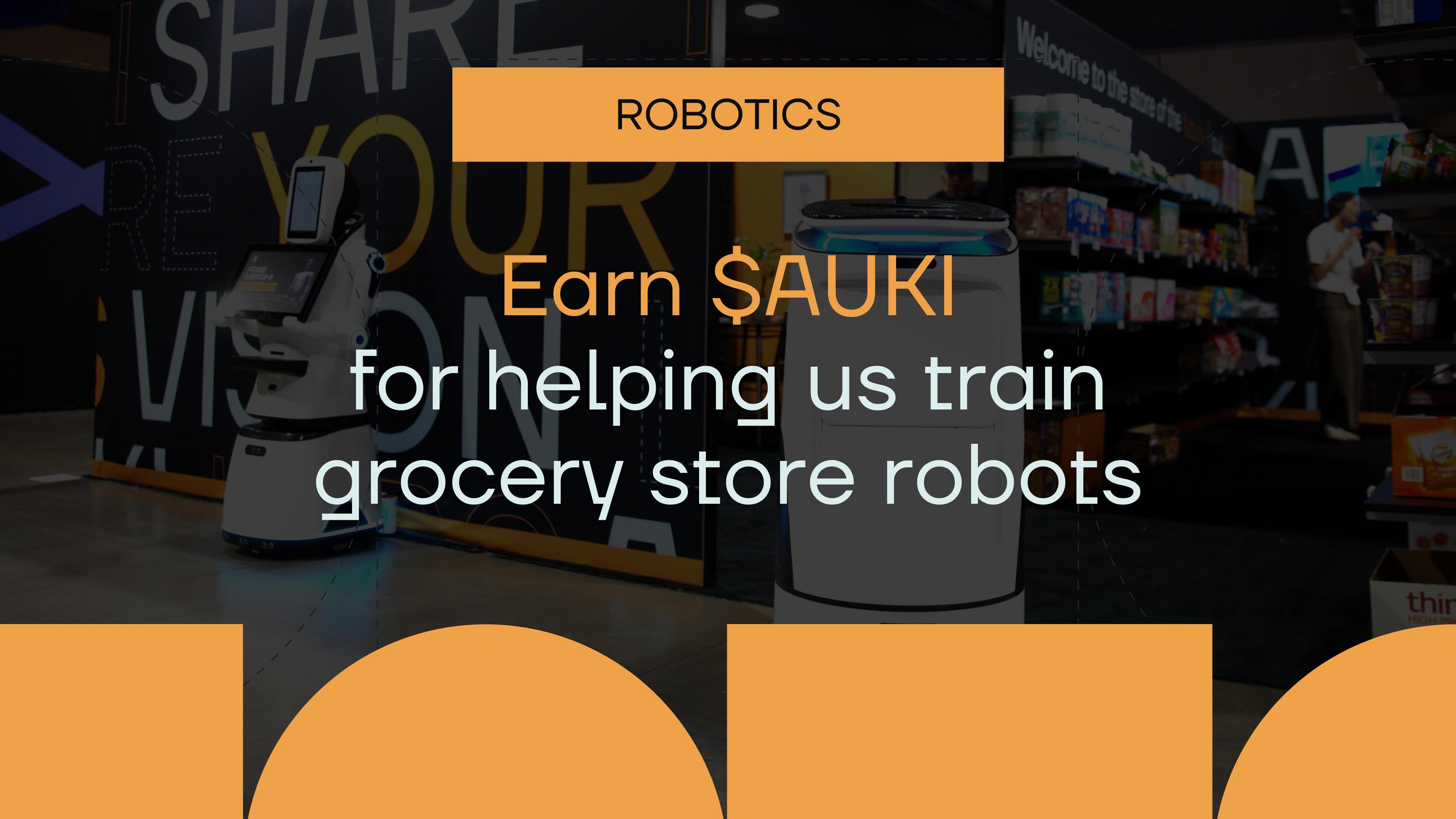
Deploying 500 robots in the wild is one of Auki’s main goals for 2026. And we want to send them out to do real, value-generating work.
Our robots won’t be folding laundry or loading dishwashers like you’ve seen many demos of humanoid robots doing. Those types of manipulation tasks are difficult both technically and financially, since the unit economics of shipping individual robots to people’s homes to do chores don’t really make sense unless it’s an exercise in subsidizing data collection.
Instead, we’ve realized that there are many “looking and pointing” tasks that are much more valuable than manipulation tasks. For example, in retail stores, robots without any sophisticated manipulation capabilities can do a few jobs already just by connecting to the real world web and Cactus, our spatial AI platform:
By giving them remote access to the robot, field reps can skip the many hours of driving to stores and simply connect to the robot, ask it to drive over to the shelf, and inspect it remotely.
We call this telespectating, and it’s so appealing that two of the world’s biggest brands have already told us they’d consider paying for the entire robot to be in the store just so they can use it for this.
A robot that does just these three jobs is already a no-brainer at our planned price of $100/day. In the following years as manipulation capabilities catch up, the same robot will be able to do even more, like order picking and restocking.
In the meantime, we’re looking for some help collecting training data for the customer guidance task in the form of questions/requests.
What would you ask a robot in a grocery store? Please send us audio recordings of up to 5 questions/requests per person, English only. As long as they’re intelligible and sensible, we’ll reward you 500 $AUKI per question.
Here’s the form: https://forms.gle/nW8UAWWmNTpTVxLP9
We’ll close it after the first ~100 responses.
Thank you and we look forward to deploying robots in grocery stores next year with the community’s help!
Auki is making the physical world accessible to AI by building the real world web: a way for robots and digital devices like smart glasses and phones to browse, navigate, and search physical locations.
70% of the world economy is still tied to physical locations and labor, so making the physical world accessible to AI represents a 3X increase in the TAM of AI in general. Auki's goal is to become the decentralized nervous system of AI in the physical world, providing collaborative spatial reasoning for the next 100bn devices on Earth and beyond.
X | Discord | LinkedIn | YouTube | Whitepaper | auki.com
