Join the movement and participate on Uniswap.
Participate

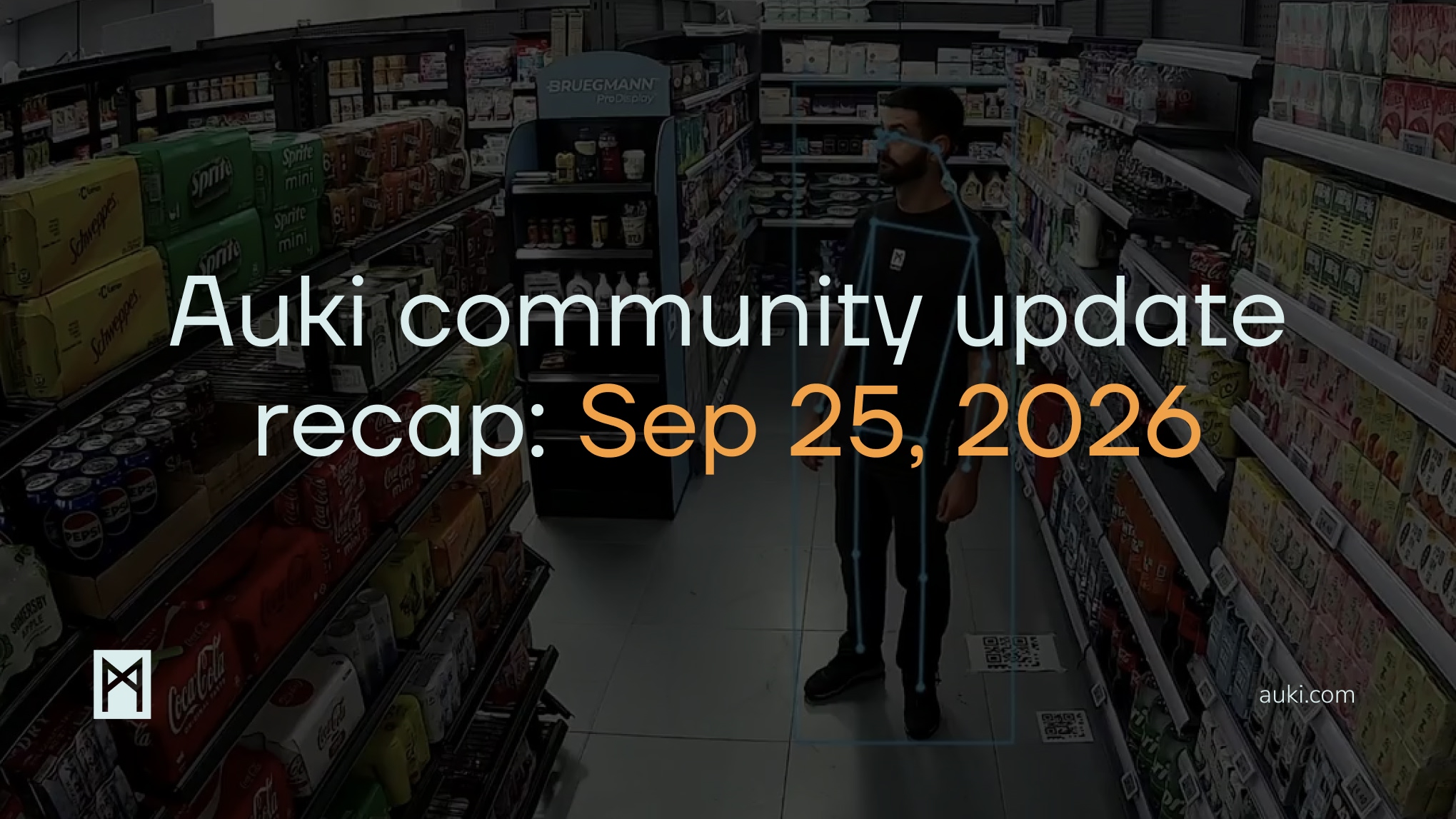
Ordinary RGB cameras can tell a retailer which shelf got the eyes. The person never enters the record. A clip from our Hong Kong lab made that point, and a lot of people still called it a privacy violation.
The setup is a digital twin built from a smartphone, ordinary CCTV, and a colleague walking a simulated supermarket. From 2D video we put him in 3D space and projected where he was looking onto the shelf. We filed the patent two years ago. We finally built it end to end.
The visualization shows a person because that's how you explain the geometry. Nothing about the shopper is stored.
"We do not track the person."
In the demo, CCTV sits in a digital twin that already exists. No special hardware. Pose in the aisle, gaze on the shelf, then a heatmap: redder products got more eyes, bluer products got fewer.
"The only thing that ends up getting saved is what part of the shelf received attention — and not by who."
This is not live in any store. We already sell other spatial and robotic services to retailers. Shelf attention is a lab demo.
We will look at terms of service with our lawyers so customers cannot use this for person tracking without expressed consent. We are not going to blanket-ban consented tracking any more than we would ban a loyalty card. Nils doesn't carry one. Plenty of people do. That's their trade.
Technically, a retailer could try to join this to other data they already have. In much of Europe, GDPR already limits what you can run on CCTV even when the camera is legal. To the best of our reading, aggregate shelf attention is a legitimate business interest, with the usual disclosure. A kitchen knife can stab someone. That doesn't mean we shouldn't ship knives, and it doesn't mean we shouldn't write the contract so our customers can't.
Sales data misses the miss. People look and don't buy — price, placement, hesitation. Stack aggregate attention on aggregate sales and you see the gap.
Replenishment is the other hole. Checkout deducts inventory. It doesn't catch shrinkage, breakage, or a delivery that was short. Big retailers still struggle with a spatial question: can another ten packs of coffee even fit on that shelf? Trucks leave with a double-digit percentage of empty air, run more often than they should, and burn more miles than the goods require.
Digital twins — with or without gaze — are how you load the truck and stock the bay so those miles, and the CO2, go down. Prices follow the same math: better revenue per square meter, lower rent per product sold.
A German viewer asked why we were hyper-optimizing capitalism instead of worrying about warming. That's the answer.
Warehouses and factories have also written in — forklift attention, safety alerts. We're taking those conversations. Retail is still the focus.
We've been writing about this since 2021. Part four of the white paper is Glassholes & Privacy. Tesla, Apple, ByteDance, Snap, Google, and Niantic all turned to the camera to solve positioning. Pokemon Go players helped build Niantic's map. Consent often sits with a third-party developer. When the cameras move from pockets onto faces, those companies are looking through your eyes.
"No company should be able to build a profile of how we live our lives."
A local grocer, with disclosure and in many places with legal limits, understanding which products in their store get traffic is not the same as Google knowing what you looked at in every store, in traffic, and at home. Meta and Google's business is the profile. Ours is not. Investors have asked us to collect the data. The answer has been no since we started.
You don't have to trust Auki with your data. Whether you trust your retailer is a different conversation, and we don't fully control it. If you're worried, read the privacy policy on your credit card and your loyalty card.
Auki is making the physical world accessible to AI by building the real world web: a way for robots and digital devices like smart glasses and phones to browse, navigate, and search physical locations.
70% of the world economy is still tied to physical locations and labor, so making the physical world accessible to AI represents a 3X increase in the TAM of AI in general. Auki's goal is to become the decentralized nervous system of AI in the physical world, providing collaborative spatial reasoning for the next 100bn devices on Earth and beyond.
X | Discord | LinkedIn | YouTube | Whitepaper | auki.com