Join the movement and participate on Uniswap.
Participate

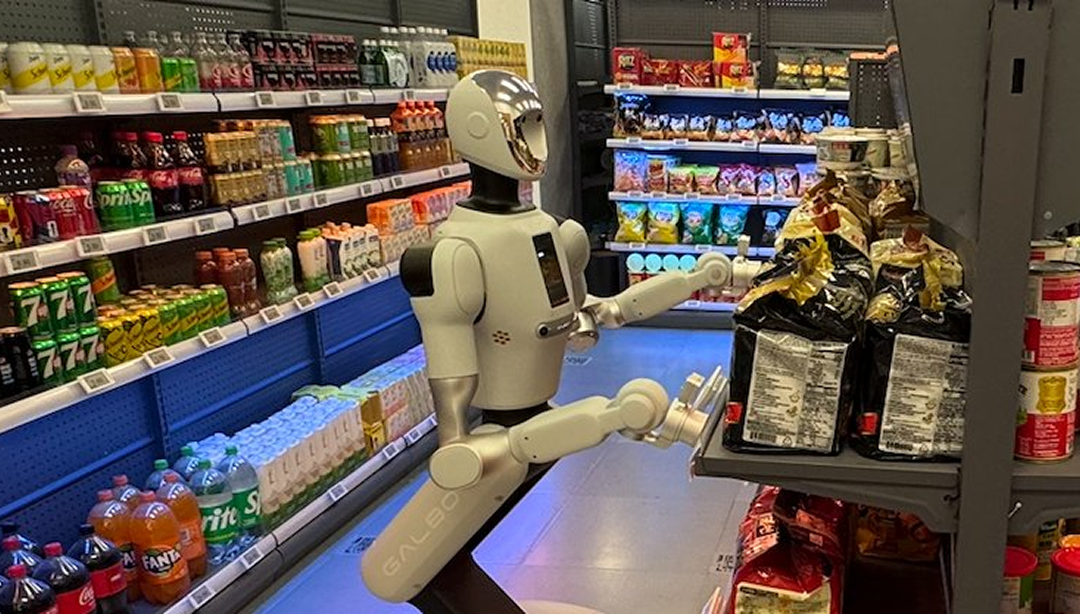
More people will be employed in the retail sector by 2035, not fewer, as a result of automation of robotics.
AI and robotics is having a self-inflicted PR crisis. Outside of the bubble of people who will have this article fed to them by the algorithm, everyday people are fearful and angry with the companies that openly say they're about to take their jobs.When 70% of the world economy is tied to physical locations and labor, both by GDP and by headcount, you can easily understand people's worries. We've literally been shushed while walking the halls of our customers for too carelessly using the word "automation".
The workforce is afraid of losing their livelihoods, and the corporations are afraid of alienating their workforce long before the robots are a viable alternative. A real blocker to data collection in live environments today is the fear that the staff will revolt at the implication of training their replacements.
After a private demo of our latest robotics advancements, a visibly fearful COO of a billion dollar retailer asked us how soon we'll all be unemployed.
The reason I call the PR crisis self-inflicted is because, as an industry, we've painted a myopic and dystopian version of the future, or foolishly left it to the population's imagination to themselves try to come up with the vision of what abundance really looks like - for them.
If your goal as a robotics company is to replace labor, don't be surprised if you face resistance. But what else is there? How do we use the most powerful technology humanity has ever invented in the service of humanity?
Few places reveal a community's quality of life and economic conditions as clearly as their local grocery store. This is where you see what goods people actually have access to, and how easy it is to make healthy or sustainable choices. The local store is a window into everyday life that is difficult to fake. Maybe this is why grocery retail so often becomes a focal point when society is wrestling with difficult questions and major change.
Today, one of the great questions looming on the horizon is how AI and automation will affect our lives, employment, and the way we relate to one another. I often encounter, from friends, family and potential customers, a deep concern that AI and robotics might harm society, and that the jobs and career paths that exist in grocery retail today will come to gradually disappear.
It's a reasonable concern. Grocery retail is so intimately connected to daily life, to our local communities, and to unusually broad opportunities in the labor market. It is a sector where someone can get their first summer job, but also build a lifelong career. It offers pathways for people at many stages of life, with different ambitions, abilities, backgrounds, and needs.
But is it really correct to assume that automation will reduce the number of available jobs in the sector, or that those jobs would somehow become qualitatively worse? To understand the coming decade, it is worth looking at moments when automation has had precisely the opposite effect.
In the 1860s, deep into the Industrial Revolution, the economist William Stanley Jevons warned in The Coal Question that Britain had become dangerously dependent on coal. The country’s future prosperity rested on access to cheap energy, and Jevons saw that dependence as an existential risk.
Many believed that more efficient use of coal would solve the problem, that more efficient steam engines that required less coal to do the same amount of work would make sure Britain's coal reserves would last. Jevons pointed to the opposite mechanism. When James Watt’s more efficient steam engine made coal more useful, it also made steam power economically viable in more parts of society.
Jevons’s insight was that when an expensive and limited resource can be used more efficiently, the result is often not reduced consumption, but new and unforeseen ways of using it. The improved steam engine did not make each kilogram of coal less valuable. It made each kilogram more valuable, because more tasks could suddenly be performed with steam power.
After his time, this observation came to be known as the Jevons paradox: the idea that more efficient use of a resource does not always reduce total consumption, but can instead increase it, because the resource becomes useful in more parts of the economy.
(@hankgreen recently posted this great video on the Jevons paradox: https://www.youtube.com/watch?v=a6sYYrLTOjQ)
A similar phenomenon appeared a century later with the arrival of the ATM. It would have been natural to assume that cash machines would lead to fewer banking jobs and less human/personal banking experience. After all, the ATM automated one of the bank branch’s most basic services: checking one’s balance and withdrawing cash.
But employment did not collapse. While it was true that automation allowed each bank branch to hire fewer bank tellers (the average went from 20 to 13, if memory serves), it was also suddenly more economically viable to open more branches. What followed was a rapid expansion of local urban bank offices, where the tellers had more time to spare for the customers' more complicated questions. The time that was previously spent on the mundane checking of balances and basic withdrawals could now be spent on personal banking. The total amount of bank teller jobs in the US grew by roughly 10%, and the amount of bank branches grew by over 40%.
That effect lasted for half a century. Only later, with internet banking and smartphones, did the physical bank branch begin to lose its central role.
When we say that we work on robotics for retail, everyone's natural instinct is to assume that we're working on solving shelf restocking and order picking. To be honest, that was our own first assumption of where the value of a robot would be - but we were wrong. After getting to work with some of the world's largest and most successful retailers (and literally donning the apron myself to get my hands dirty in the stores), we learned something surprising:The physical world needs more brains more than it needs more muscle. The true bottlenecks to better run businesses in the physical world is very rarely cheaper access to labor, but more efficient resource allocation and more intelligent decisions made in the field.
Physical businesses essentially operate by running a loop:
Capture - gather information about the state of the world.
Analyze - interpret the information to gain insights.
Decide - determine your next course of action.
Execute - perform the task.
How well your business runs is essentially a function of how good your organization is at each one of these steps. You may be excellent at data capture, but poor at analysis, just as you might be great at executing on bad decisions.
The myopic view of robots is that their value is constrained to the execution layer - it's also wrong. The robot is ultimately just an embodiment for AI, and AI can help you with the entire loop, provided it has the necessary spatial, physical and business context to reason about the world it operates in.
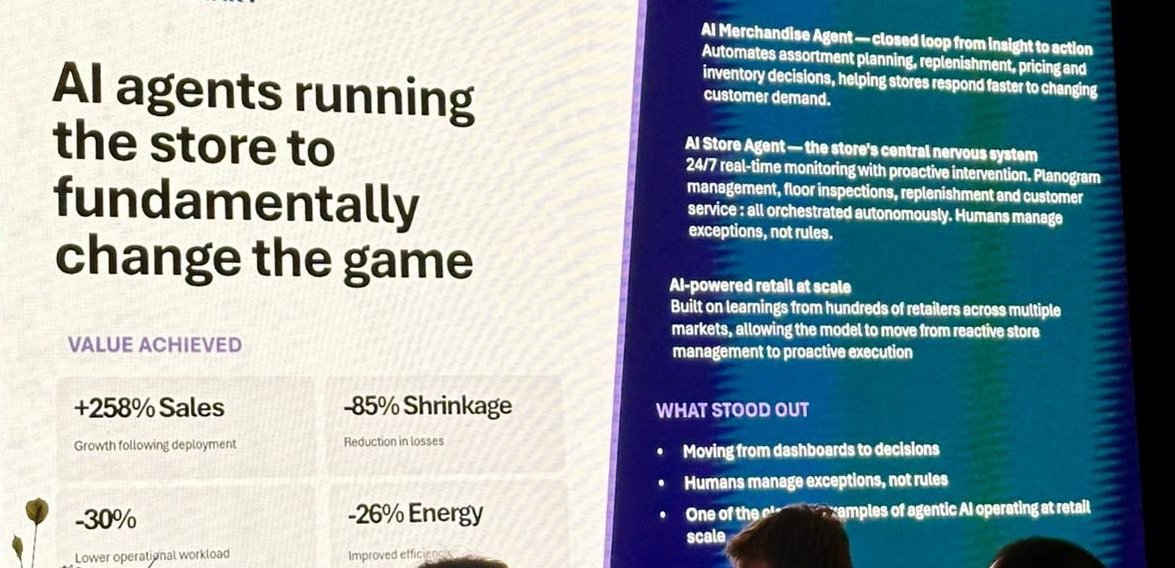
One of China's most successful retailers recently shared at a conference in Europe that they had boosted sales by a mind-boggling 250% by letting AI run their business. Today, they let their battery of AI agents choose what products to carry, how to price them, when to replenish, etc, and they are increasingly using sensors in the store to capture what's working and breaking in real-time.
Sales more than doubled. Shrinkage (theft and lost/misplaced products) reduced down to a fraction, operational cost down by 30%...Allowing physical AI to assist you on the frontline with data capture, analysis and decision-making often has a bigger impact on the bottom line than reducing the cost of labor.
If the greatest opportunities are to improve data capture, analysis and decision-making, it allows us to re-imagine the role of the robot and its impact on the workforce.One of Europe's largest retailers recently told us that they estimate that they lose 30-60 minutes per employee per day, predominantly in the morning, due to the staff not having a clear enough idea of what to do - and that's not even factoring in all the time suboptimally spent doing things that could wait.
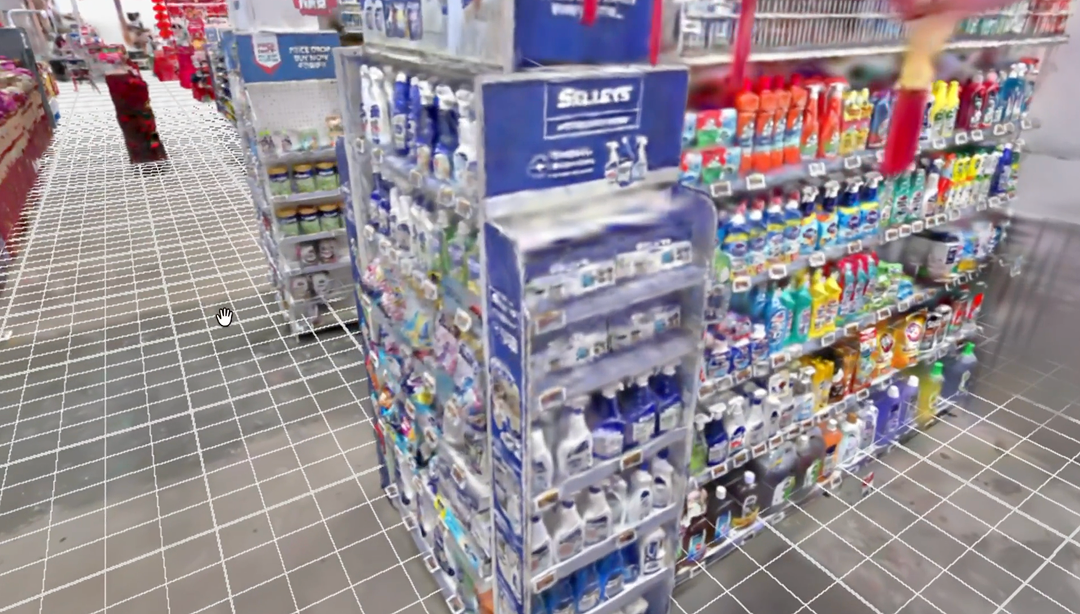
What they wanted from us was not a robot that could restock the shelves, but an AI system that could better coordinate their frontline. They wanted a night-shift store manager that autonomously surveys the store to identify the highest value actions for their human staff to focus on in the morning - and that'd be worth over 100 dollars per robot per day.
The physical world needs more brains more than it needs more muscle.
One of our existing customers offers 3x the referral bonus for recruiting a store manager vs recruiting a worker. The bottleneck is not the muscle, but you'd never figure that from sitting in the lab or reading VC think pieces - you have to get your hands dirty alongside the customer to find where the true opportunities really are.
The tasks best suited to automation are not necessarily the jobs people already do today. Often, they are the tasks that have been too expensive, too repetitive, or too impractical to hire anyone to perform properly in the first place. The robots are not there to replace human hands, judgment, or service, but to let our AI autonomously collect the context it needs to make better decisions.A robot can report in minutes how well a shelf is maintained, which products are missing, which displays are not working, and which actions would improve the customer experience. That is not a substitute for the people in the store.
Solving these problems for the retailer will make its human staff more valuable. Just as with ATMs and local bank branches, we're confident that this path will lead to more and better jobs in retail, to better run stores, more efficient logistics, lower prices - and step towards abundance that does not replace anyone or remove their dignity.
AI and robotics will make it easier to open more stores, closer to where people live, with stronger local connection and more personal service.
We choose to go this path not only because it makes economic sense, but because it appeals to our humanity. Technology should be in service of the community, and we take great pride in using AI and robotics to create a world where there are more opportunities for employment, entrepreneurship and meaning.By the end of 2030 we predict we will have deployed over 100,000 store manager robots in grocery retail alone. By Christmas next year we anticipate that several million people will see an Auki robot in real life at least once a month, and tens of thousands of retail workers will be coordinated by a physical AI system with own eyes and ears in the world - and not a single job will be destroyed.The same pattern will repeat itself across much of the world's supply chain and frontline. Warehousing, logistics, agriculture, healthcare, hospitality - 70% of the world's economy, made more efficient, more resilient and more sustainable through the intelligent coordination of resources. Brains, not muscle.This is what abundance looks like.
Authored by Nils Pihl, CEO @ Auki Labs
Aukiはポーズメッシュという地球上、そしてその先の1000億の人々、デバイス、AIのための分散型機械認識ネットワークを構築しています。ポーズメッシュは、機械やAIが物理的世界を理解するために使用可能な、外部的かつ協調的な空間感覚です。
私たちの使命は、人々の相互認知能力、つまり私たちが互いに、そしてAIとともに考え、経験し、問題を解決する能力を向上させることです。人間の能力を拡大させる最も良い方法は、他者と協力することです。私たちは、意識を拡張するテクノロジーを構築し、コミュニケーションの摩擦を減らし、心の橋渡しをします。
ポーズメッシュは、分散型で、ブロックチェーンベースの空間コンピューティングネットワークを動かすオープンソースのプロトコルです。
ポーズメッシュは、空間コンピューティングが協調的でプライバシーを保護する未来をもたらすよう設計されています。いかなる組織の監視能力も制限し、空間のプライベートな地図の自己所有権を奨励します。
分散化はまた、特に低レイテンシが重要な共同ARセッションにおいて、競争優位性を有します。ポスメッシュは分散化運動の次のステップであり、成長するテック大手のパワーに対抗するものです。
アウキ・ラボはポスメッシュにより、ポーズメッシュのソフトウェア・インフラの開発を託されました。

