Join the movement and participate on Uniswap.
Participate


In this week's community update, Nils walked the audience back through Auki's core thesis: the 70% of global GDP still tied to physical locations and labor remains largely untouched by frontier models. The company is building the harness that lets those models actually interface with retail, manufacturing, logistics, and agriculture.
Most people assume a restocking robot's job is straightforward execution. Nils used the empty shelf as a concrete example of why that view fails. When a robot (or a human) sees an empty shelf, it still needs to know:
Without that business and spatial context, the robot requires constant micromanagement. One European retailer with over 10,000 floor workers estimates staff lose 30–60 minutes per employee per day simply because they are unsure what they should be doing next. The bottleneck is not muscle. It is the capture-analyze-decide loop.
Auki frames every physical business as running the same loop (the business version of the military OODA loop):
Nils noted that most robotics companies assume their value is only in the execute layer. Retailers have shown the opposite: the biggest multipliers sit in capture, analysis, and decision-making. The front line needs brains more than it needs muscle.
As external validation, Nils pointed to Wumart, one of China's largest retailers, which has been letting AI run core merchandising decisions (assortment, replenishment, pricing) for a decade. The results included a 258% sales increase, 85% reduction in shrinkage, and 30% lower operational complexity.
Cactus is the name for the store brain that closes this loop. It ingests spatial data from phones, glasses, webcams, shelf cameras, and now robots, then surfaces actionable recommendations. The goal is to remove the cognitive load that currently sits on store managers and floor staff.
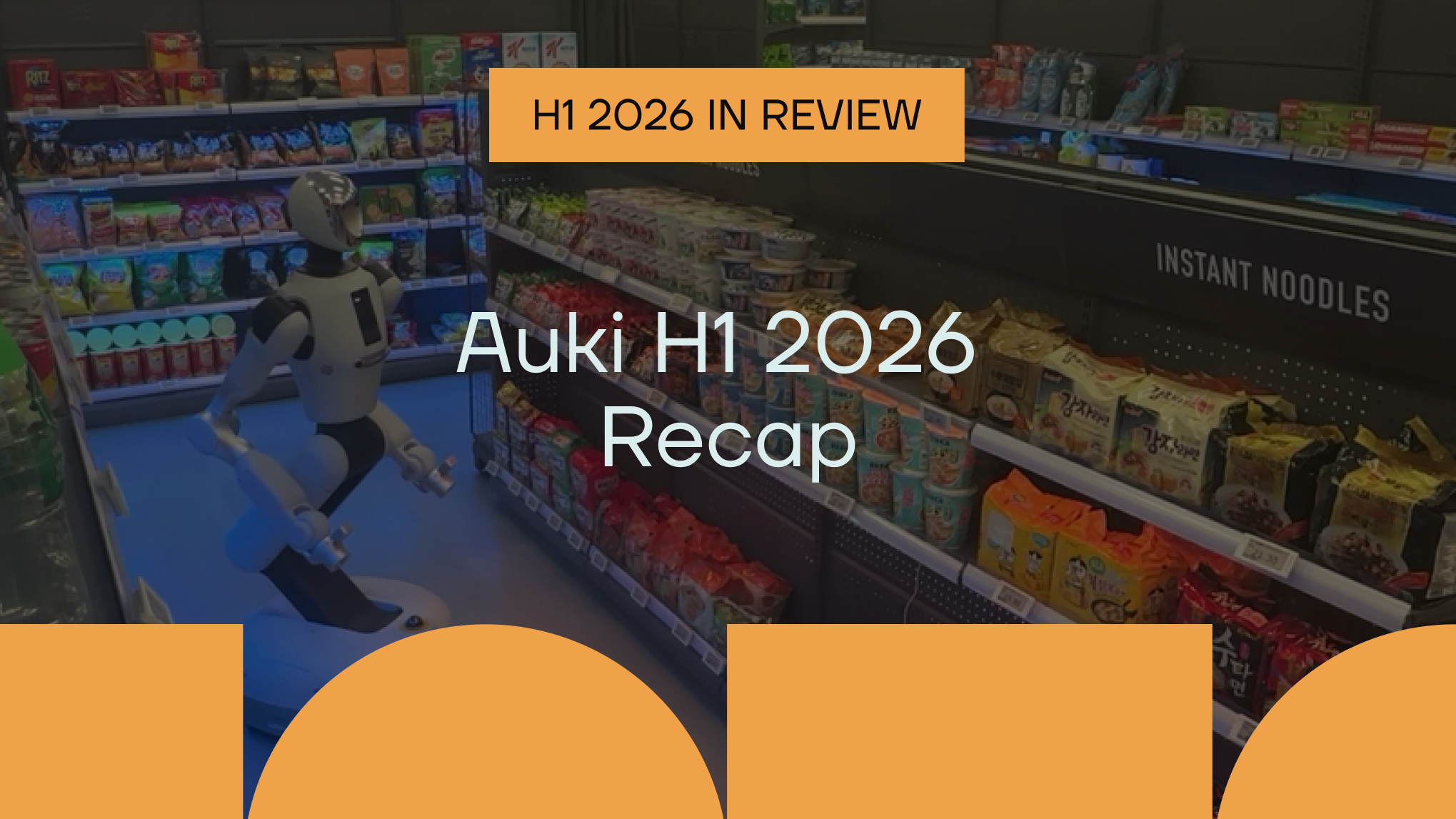
This year Auki will begin deploying semi-humanoid robots (Galbot G1 and RealMan) specifically to feed the capture layer autonomously. The robots are not being sent in primarily to restock or execute tasks. They are being sent to collect the data the store brain needs to make better decisions and then delegate the right tasks to humans and machines.
Nils shared several pieces from the most recent internal demo day:
The current perception speed is 10 seconds per product place, giving a single robot substantial coverage per hour with far more detailed reporting than manual checks.
Tracy gave a snapshot of the first half of the year:
One data point stood out: if Auki hits its shared deployment targets with its largest Swedish customer by the end of March, roughly 50% of Sweden's population will walk through an Auki domain in a given month. By 2027 the figure is projected to reach upwards of 75% of the population having visited at least once.
Nils closed with the economic logic behind the 100,000-robot, 100,000-store goal by 2030. Historical precedent (the ATM) shows that automating a narrow, time-consuming task can dramatically lower the cost of operating a location, leading to more locations and therefore more jobs overall.
The same dynamic is expected in retail. Today staff spend significant time searching for products or doing task handovers. Removing that friction makes each worker more valuable, makes new stores more viable to open, and creates demand for higher-skill roles. The target is explicit: 100,000 robots in 100,000 stores without removing a single retail job.
Auki is making the physical world accessible to AI by building the real world web: a way for robots and digital devices like smart glasses and phones to browse, navigate, and search physical locations.
70% of the world economy is still tied to physical locations and labor, so making the physical world accessible to AI represents a 3X increase in the TAM of AI in general. Auki's goal is to become the decentralized nervous system of AI in the physical world, providing collaborative spatial reasoning for the next 100bn devices on Earth and beyond.
X | Discord | LinkedIn | YouTube | Whitepaper | auki.com