Join the movement and participate on Uniswap.
Participate

Auki's May 30 community update covered the new public SDK, live robot perception demos, a major step forward in scene reconstruction, and continued community data annotation.
The team launched a new public GitHub repo for the SDK at github.com/aukilabs/auki-sdk. It is still very experimental, with many daily PRs and frequent breakage, but it is fully open. There is also a public Kanban board where anyone can see open questions, file suggestions, and track priorities.
Nils noted that for anyone who has been DMing about working at Auki, the most effective path is to make PRs on the repo. Even strong questions or suggestions on the Kanban can get attention. The SDK work includes new browser peer-to-peer via WebRTC and upcoming Swift/iOS bindings.
The core goal is making it effortless for any peer — browser, robot, phone, or glasses — to join a domain and exchange sensor data for collaborative spatial computing. Example apps for the P2P networking are already available to try.
Phil has been focused on getting the Realman RS-02 to reliably scan the lowest shelves. The grippers only reach about 30 cm above the floor, but the required scans go down to 15 cm. The team is actively solving the low-shelf problem.
Both the Realman RS-02 and Galbot G1 are now running autonomous shelf scanning in the demo store. A new “Storecraft” demo shows a more mature Cactus UI where a store manager can see the store layout, select a robot, and task it to a specific area — essentially controlling the robot like a game of StarCraft. Watch the Storecraft demo here.
Significant progress was made on scene reconstruction. A new depth regularization feature makes Gaussians adhere much more closely to the actual geometry of the environment instead of floating in space. The before-and-after comparison shows both better photorealism and dramatically improved geometry extraction from RGB video.
This work (Elden’s) will enable higher-quality 3D models from ordinary video and is expected to appear in a paper later this year.
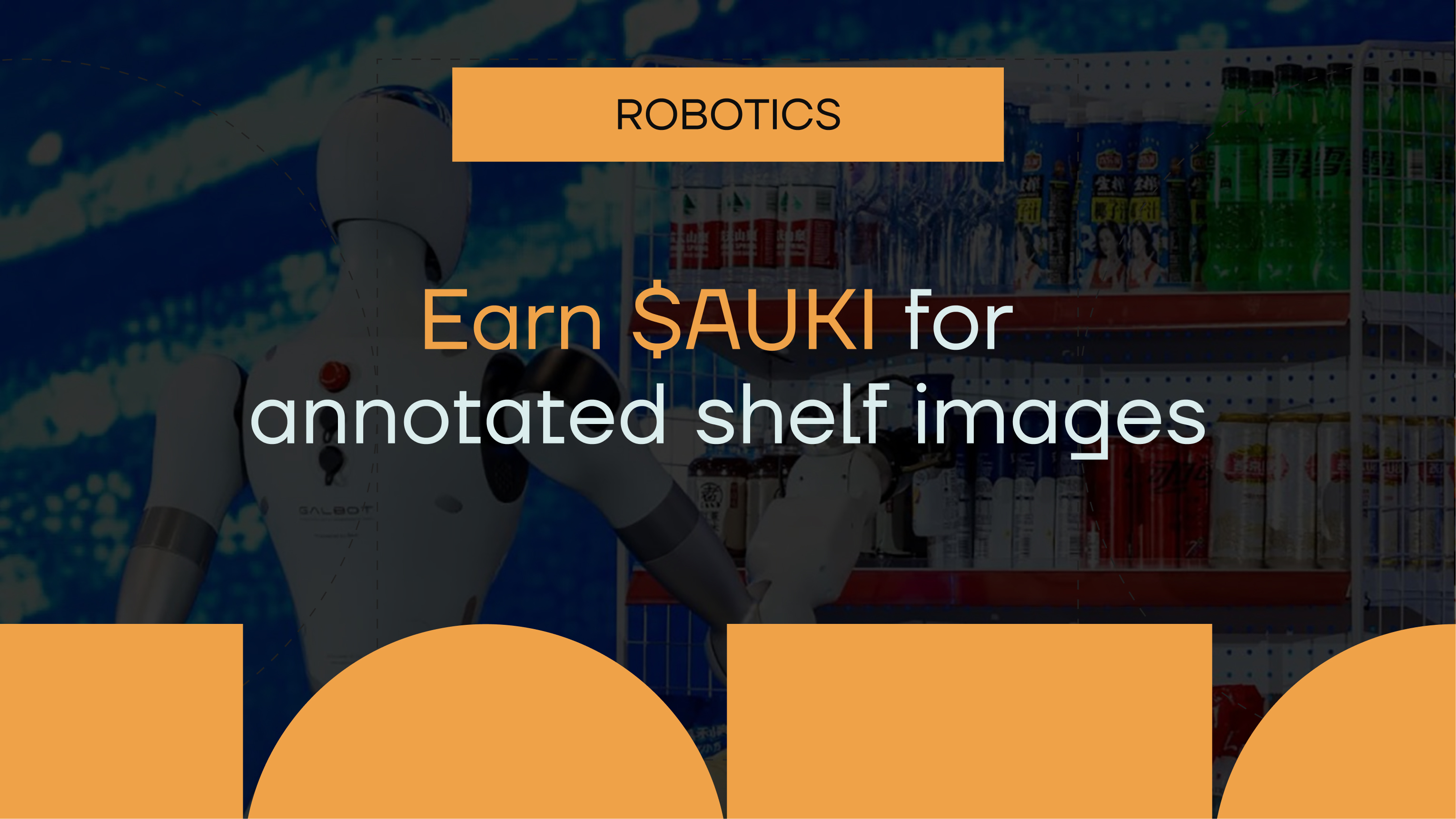
The shelf annotation effort is now at roughly 300 images — up from about 100 two weeks ago. This puts the project about a quarter of the way to the minimum goal. Contributors can both capture images and annotate them; the team is also preparing to pre-load additional images so people can focus purely on annotation. The work is paid in tokens and directly improves the robots’ ability to read real retail environments.
Nils is flying to Europe next week to meet with one live customer and one upcoming customer, facilitate a joint workshop, and work through the logistics of the first robot rollouts. The next community update will be from Europe.
Auki is making the physical world accessible to AI by building the real world web: a way for robots and digital devices like smart glasses and phones to browse, navigate, and search physical locations.
70% of the world economy is still tied to physical locations and labor, so making the physical world accessible to AI represents a 3X increase in the TAM of AI in general. Auki's goal is to become the decentralized nervous system of AI in the physical world, providing collaborative spatial reasoning for the next 100bn devices on Earth and beyond.
X | Discord | LinkedIn | YouTube | Whitepaper | auki.com